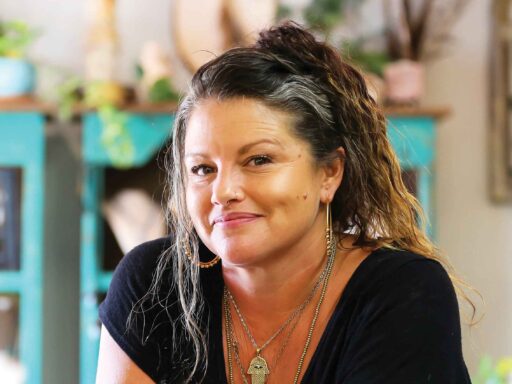



More than Numbers
Take care of people first. Success will follow.

Kim Blohm has learned that growth often comes quietly — and from places you least expect. As president and CEO of the Greater Boerne Chamber of Commerce, she has built a reputation for spotting those moments, nurturing them and cultivating lasting change. Whether it’s rallying small businesses during a pandemic, championing nonprofits or helping new residents feel like neighbors, Blohm leads with strategy, service and heart.
Since becoming president and CEO of the Greater Boerne Chamber of Commerce in 2019, Blohm has earned widespread recognition. Most recently, she was named one of the Association of Chamber of Commerce Executives’ “40 Under 40” honorees in January 2025. This honor follows her being named U.S. Small Business Administration’s Small Business Champion of the Year by the San Antonio District Office in March 2024 and being selected for the San Antonio Business Journal’s prestigious “40 Under 40” list the same year.
Blohm’s approach blends authenticity, creativity and collaboration. She said that she “can’t turn it off” when it comes to connecting people and spotting opportunities. She shared that someone once asked her, “Is your brain always on?” She said, “I guess it is.” She genuinely cares, especially because Boerne is where her kids are growing up, where she and her husband plan to grow old and where her parents now live. That deep personal connection to the community makes it impossible for her to stop looking for ways to help, from calling every chamber member during the height of the COVID-19 pandemic to ensure their well-being, to creating innovative events such as Diva Night and pickleball tournaments.
She’s a people-first leader with a marketing mind, a deep local network and a soft spot for goats, gardening and good ideas. Blohm and her husband have three children — a 12-year-old daughter, an 8-year-old son and a 4-year-old daughter—who inspire her daily commitment to making Boerne the best possible place for everyone who calls this community home.
Boernean: So you stepped in seven years ago, right?
Blohm: I came in 2018 as Vice President of Marketing and Membership. And then in 2019, I became the President/CEO.
Boernean: And your membership has doubled since then?
Blohm: Yes, we’re a little over a 1,100 members.
Boernean: To what do you credit that success?
Blohm: I think really my team and my board. I have an amazing board of directors that are volunteers — we’re a nonprofit. So, their vision and their trust in me as their leader, as the President/CEO, allows us to be flexible. They allow us to be authentic and real, so that members come in and they feel important. They feel heard, they feel, you know, valued. Where it’s not just a churn mill. We’re not here just to get members, and then members get out.
Boernean: Would you say there is a certain level of creative freedom?
Blohm: Yeah, they trust me. They’re like, ‘Hey, you can do what you need to lead, hire the team that you need to hire — obviously, within the budget.’
Boernean: Okay, so what specific leadership decisions or strategies would you say drove the growth or helped?
Blohm: Really, it’s been making sure that our membership is relevant. The services we provide have to be relevant. They can’t be the same people doing the same thing: drinking, and eating with the same people.
It has to be inclusive. We say, ‘Here, everyone belongs.’ And it really is true. When you come in, I want you to have that “wow” experience.
I want you to be like, ‘Wow, I felt included.’ Everyone wants to feel that way, right? Everyone wants to be included. You want to feel important. So, when my board says you can be free to change programming, add programming, add services, change events or add an event that members want — it adds value to them. And that’s the value in what we do. So, that’s why members come and they stay.


Boernean: What would you say are some of your favorite changes that you’ve made, or new programs or events that you’ve added?
Blohm: We’ve added pickleball. I think we’re on our fourth year doing it. And that came out of our golf tournament which sold out within two days with 144 players.
And so we asked, what else can we offer? People want to be involved. They want to sponsor something. And so, we went with something that’s trending in the space.
We got some businesses that provide pickleball training, so they come and do beginner pickleball clinics for anyone who has never played before. It’s a fun little networking game, and it’s a different dynamic. I think we cap it at 75 players. It’s fun just having everyone out there with different energy. We do it in October, so it’s nice fall weather, and it’s just been really fun and successful.
We started International Women’s Day in partnership with the Hill Country Family Services. The chamber has now officially taken over [the event]. We bring in different women leaders in our community to share their story, share their success and be there for other women in leadership. We like that program.
And then probably Diva Night would be my top three. It’s a late-night shopping event for all of our retailers. It helps them get a boost in sales before the holiday events or before the lull of summer. And that’s really fun. We usually have about 2,000-plus women come out on Main Street. The chamber officially took it over as our event. We were helping the retailers host it and training them and working alongside them to help them, because they’re small businesses. But it really became evident that we just needed to take it on and do it. It’s fun because now we can incorporate our other small business owners, not just the retailers. Other small businesses can set up little booths on the main plaza. We have med spas, we have pet training and we have yoga.
t can be just everything. It doesn’t just have to be retail. It shows a lot of community collaboration. We have a lot of people come out.
Boernean: That’s fun. When is that?
Blohm: It’s going to be in November. And we have a spring one — Spring Fling.
Boernean: Do people purchase tickets?
Blohm: No, it’s free for the community. We just want you to come out, shop and get to know some of our businesses.
Boernean: ACCE praised your ability to dismantle siloed leadership. Can you walk us through an example of how you united disparate groups within the community or your business ecosystem?
Blohm: So, I would say the nonprofit sector. We have over 150 nonprofits in the chamber right now. Many other chambers will typically have them be their own chamber, council, or hub. We have, since the beginning, strategically focused on treating them like a business. So, we’re teaching them, we’re folding them into the ecosystem of the chamber. We’re teaching them business classes, how to do grant writing and how to run their nonprofit like a business. And we even led the economic impact study. We partnered with the Kronkosky Foundation who funded it, and it showed Kendall County that there are 400 registered nonprofits and 144 of them file a complete 990 meaning that there’s a certain revenue threshold that they reached.
And then we studied the nonprofits — we hired two professors from Trinity University and they came in and they analyzed it. They actually did a similar study for San Antonio, but we’re Kendall County, so I had them do it for us. It showed that over $50.3 million is put back into the local economy from nonprofits alone. Meaning that’s the staff, that’s the workers, that’s the products, that’s the services — whatever it may be — put back into the Kendall County ecosystem. That’s more than the general budget for the county and the city combined.
Boernean: Oh, wow.
Blohm: Often, what is a missed opportunity is the nonprofits — they need the for-profit businesses, but the for-profit businesses also need the nonprofits. For-profit businesses sometimes have a certain amount that they have to give away in their budget, and if they don’t donate it, they lose it. A lot of the manufacturers or different partners will say, ‘Hey, you know, in Kendall County, your business has to spend X amount on the community.’ Well, if they don’t spend that in our community, the next year they won’t get that money.
We like to be a connector and say, ‘Hey, this nonprofit does veteran service, this one has a need, the women’s shelter needs a new playground,’ as an example. And we’re able to connect for-profit businesses with nonprofits, and we’re able to create a real synergy.
Boernean: That’s pretty cool.
Blohm: It’s pretty cool. It’s one of my favorite things, probably.
And that’s why they’re all here. They want to run a successful business too and collaborate. We started the Nonprofit Lunch Bunch, where they all come together to network and learn about each other. They’ll do a presentation on what they do and then someone’s like, “Oh my gosh, I didn’t know you did that!” Or if they have a client that comes in with that need, they can now reach out to the other nonprofit locally for support versus going out of our community.
Even for our calendar, for example, a lot of them are like, ‘Well, so-and-so’s doing their golf tournament the same day I’m doing mine,’ or, ‘The banks said they already funded this other one.’ And so to be able to say, ‘Hey, check the calendar. See what day they’re hosting their event. Don’t host it on the same day. Work with them. Now many of the nonprofits will even have booths at each other’s golf tournaments. So we’ll go volunteer and help them take pictures. But we’re out at their booth, and we’re meeting all the business owners that are out there playing. It’s showing who we are at the chamber and what we do. And then, we’re also helping the nonprofit get pictures and awareness of their event.
Boernean: That’s impressive. That is a solution I think more people should adopt in their community. So, you were recognized by the San Antonio Business Journal and the ACCE?
Blohm: Yes, I was 40 Under 40. I turn 40 next week, so I just snuck under the cut-off.
Boernean: Well, that’s perfect timing. Congratulations. In another article from SABJ, you emphasized the importance of businesses adopting technology. So, what tech initiatives has the chamber launched for local businesses, and how are they performing?
Blohm: Leaning on your website. We have a little over 300,000 visitors to our website each year. Focusing on SEO for small businesses. I just had a member today say, ‘I don’t have a website, and I don’t feel like I need one.’ I’m like, ‘Okay, well, when you Google your business, the second business showing up is the chamber referral.’ And we want to be on the first page when your business is searched for on Google. For us, that’s very important.
One is focusing on SEO for businesses, and I would say homing in on your own website as an organization to ensure that you are the leading source. The team’s done a fantastic job on social media. We’re very active on social media — from reels to LinkedIn and Facebook, and all the platforms. Sometimes you’ll see [the platform] not being as relevant. We have to go where the people are.
I would even say that during COVID, it was a learning opportunity for us. We’re a referral organization, and we’re going to support your business. We achieve this by partnering with small businesses and hosting events. Well, during COVID, businesses aren’t open and you’re not having the events because you can’t. So, we leaned in on Facebook groups, specifically like the Boerne Moms or Boerne Ladies Connections. On those pages, people were saying, ‘I need a dentist. I need a new pediatrician. I need a pool guy. I need a gutter company.’ We began referring business members from our website to those platforms.
And so, when we talk about relevance, social media spaces and digital spaces, we didn’t wait for them to come to us; we went to them. Whether it’s Nextdoor and they’re asking for a contractor, or they’ve just moved here and are looking to get their hair done, or they’re looking for facials or Botox.
Boernean: I love Nextdoor, it’s helpful because it’s basically people in your neighborhood.
Blohm: This year, we’re diving more into Nextdoor. It’s something newer, one of my initiatives. But there’s a lot. You know, we’re only a team of six so there’s only so much we can do, but we will actively engage to help people find whatever they need from the new person moving here to even the volunteer opportunities.
Back to the nonprofits. Another thing that we did after COVID, a lot of our nonprofits said, ‘Hey, we lost our volunteers. They took off because of COVID and they didn’t come back.’ We created a page on our website for volunteer opportunities. You can find three different types of opportunities, ranging from kid-friendly to those for adults 18 and up, such as voting or gardening, and even court-ordered opportunities, as some of our residents are looking for these types of services. We were the only partner in the community and resource for that.
It gives our nonprofits that exposure and that was something coming from the Boerne Moms groups and a lot of the social media pages where people say, “Hey, I want to start volunteering. I just moved here.” Or retirees who want to volunteer. I wanted to write out a comprehensive list of the 150 nonprofits that we have and the volunteer opportunities that they can pick from. Whether it’s working with horses, working in nature, working indoors, mentoring, making meals — anything. And we got to be that resource. It was turning to that digital component, finding it and finding the answer to it.
Boernean: What a great idea. When my kids were younger, especially, I wanted to find volunteer opportunities we could do together, and it was always challenging.
Blohm: Yes. You find one and then they’re like, ‘Oh, you can’t bring your kids.’ Well, that’s not helpful. Or especially around the holidays. During the summer, the city started doing a summer reading program to the pets at the shelter. So the kids are willing to read, and they’re sitting there reading to the animals. My kids did it. They wanted to come home with a cat, but we didn’t. That’s why they find them homes. But we’re good with just reading.
Boernean: That’s a really good program. And for you guys to be able to pivot like that and help the community.
Blohm: We’re connecting them to the community, potential new funders and it saves them like seven dollars an hour, which the average volunteer will save them. It does make a financial impact on that organization.
Boernean: So with the 40 Under 40, what’s the biggest lesson from that recognition in terms of your broader impact on the chamber professional landscape?
Blohm: There’s still an opportunity to learn. There’s always an opportunity. There are new connections. When you think you’ve kind of made all the connections, it just takes it to another level. And it was a wonderful honor. It was amazing. But it’s kind of twofold. One, it’s exciting because you get to show others what you can do at a young age, and you can be successful. And then also at the same time, it’s very humbling because you don’t always take a minute. It forces you to pause and see all the work you’ve done and kind of evaluate the impact you’ve made on other people. You don’t always realize it, because you’re just going about your day, doing your thing. So I thought that was kind of cool.
And the impact you’re making on people’s lives. Because I always say that it’s the people who live, work, worship, volunteer and send their kids to school with us.
I think my favorite story is when I first started at the chamber, I went to my son’s kindergarten program, and more than 50 percent of the parents were business members. I just had this aha moment. These are the people who are sitting alongside me and raising my kids, who are part of my village, and I just feel compelled to help. It matters. The success of their business impacts not only our community, but also the home life and the school life of their kids and my kids’ friends. So that’s amazing.
Boernean: Boerne is known for its protective community culture. How do you honor that local tradition while pursuing growth and innovation? How do you balance those two?
Blohm: I think it’s a matter of connecting the two. You have quote-unquote ‘old Boerne,’ I guess, and ‘new Boerne’ or whatever they want to call it. But showing people that you’re just people. We’re all people trying to do work in the same community. I think kind of humbling it and making it real. Referring back to the school thing, we’re all neighbors. We’re all there at the swimming pool together, the soccer field together. Knowing that we’re just humans trying to bring good and live a good quality of life for our families, being authentically you and accepting and treating everyone as you’d want to be treated.
Whether you’re a new business, making sure they feel welcome, or if they’ve been here for a while — advocating for newer and older businesses alike, encouraging them and dispelling myths. You’ll see comments online, but really, when you see people in person, they’re so embracing of newer and older businesses. They’re helping each other out. I think we saw it best during COVID.
I tell everyone we grew by four percent as an organization when businesses were closed during a global pandemic, and we couldn’t have events. How did we grow? We checked on people. We treated them like human beings because that’s what we are. Connecting them, newer businesses leaning in to support generational businesses, like when grocery stores ran out of milk during reopening, one established business provided milk to a newer one. It seems simple, but it gives me goosebumps to know that they care. At the end of the day, they care and they want the success of our community. It doesn’t matter if you’re new, old or indifferent — it’s their hometown.
It’s their neighbor. So that’s pretty cool.
Boernean: People do have that misconception, but we’ve been nothing but welcomed. It’s been great.
Blohm: At the chamber, nothing kills me more than hearing someone say, ‘I feel like I’m not gonna be welcome.’ That’s not going to happen on our watch with our team. You saw them coming from the meeting — everyone’s just happy to be here, happy to be of service.
Boernean: Okay, how do you strike a balance between professional demands and personal passions, free time and fun?
Blohm: I kind of let them all run together. I give out my personal cell phone number, making myself available because I’m not always at my desk. But I show a picture of my three kids and my husband, and I’m like, after six o’clock, it may take me a little bit longer to reply.
But at the same time, I think that’s what’s great about our chamber is that members are just friends and people I honor and respect. They’re just part of the whole, and my life and our life is that community.
I try gardening, and then I fall in love with nonprofits like the Native Plant Society — they’re members, then friends, then collaborators. My kids swim with Boerne Elite Aquatics, which is a member, so everything falls into one. If there’s a business question at an event, great — I’m happy to help. It’s that village mentality, cliché but true. Everyone’s here to support each other. I can’t help myself — if I see someone who needs an introduction, I do it. I like to be overly helpful.
Boernean: That’s wonderful. What are you growing in your garden?
Blohm: Right now, asparagus. Fun fact: I planted it six years ago and forgot. Did you know asparagus takes three to five years to establish? I had planted it and thought it died. Since that time, I started working here, and then I had a baby and now I have a four-year-old. So we were too busy for any of that. And then, recently, we were out in the back — my son, who was learning about ecosystems, realized that it’s important to have our own garden. So he asked if we could plant some things in the garden.
I let him pick three things that he would eat so cucumbers and carrots. And we planted pumpkins to hopefully have for the holidays. But while I was out there, I was like, ‘Huh, that looks like my asparagus!’ And my sweet neighbor, he grows asparagus, and he confirmed it. He said I should trim it off, mulch it, leave it alone and water it.
And it’s massive like a 12 by 8 garden.
t just replicates, and then by the fall, it’ll be ready to go. But you’re seeing all the little shoots come up, and it’s actual asparagus.
That’s been kind of fun. I guess I plant it, let it do its own thing and then I nurture it. Kind of like my life.
Boernean: That’s a great analogy. Do you also have goats?
Blohm: I do! Chickens, too. My kids are in 4-H, raising show goats from July/August to January for the Kendall County Stock Show. Then they sell them. We have sitter goats because they’re herd animals needing buddies year-round. Yeah, their names are Walter and Muffin.
Boernean: As you look forward, what do you see as the biggest opportunity and the biggest challenge for Boerne’s business community?
Blohm: The biggest opportunity is collaboration. New businesses partnering together. Today’s Healthcare Connections event had nearly 30 attendees in patient-care fields, all collaborating locally, adding value to Kendall County. People moving here bring talent and expertise, enhancing our community. Just last month, we added 30 new members, including a grief counselor who will collaborate with our Kendall County Mental Behavioral Health Initiative, adding crucial value.
The biggest challenge is staying relevant. With social media evolving, digital landscapes shifting and new generations owning businesses, we must continually demonstrate our value as a chamber — advocating, educating and connecting.
When I first came to the chamber world, I was like, ‘What does a chamber do?’ And so for me, that’s kind of the challenge. We can’t always control the political landscape and all the other things out there, but we can control what we do behind these walls and what we offer outside of these walls. So that, to me, is super important.
Boernean: Does connecting people come naturally?
Blohm: I guess so. I mean, I’ve always loved people. I’ve always been a talker. Lately, I tell people, that I put it out in the universe and I feel like it just falls in my lap. We had a business from out of state, a food photographer, and he wanted to get plugged in so he came to the chamber. I welcomed him and he joined and I told him, ‘I’ll be really honest, I don’t know how many food photographers are needed in Boerne, Texas, but I will do my best to help you.’
And the next day — I swear — I got a text that was like, ‘Hey, I need a food photographer, do you know someone?’ I’m like, ‘I do!’
I get excitement and fulfillment from helping others. I guess I can’t turn it off.
But I care. It’s more—my kids are growing up here. It’s where I’m, you know, going to grow old with my husband. And my parents just moved here about three years ago.
So I love having them here, too. Plugging them in. And so to me, it’s important to just find all the resources and keep it as local as possible, because it matters.
Boernean: Wonderful. Where do you want to take Boerne business or the chamber next?
Blohm: I want to continue adding value and maintain a high retention rate. But it’s more than numbers — it’s about feeling. I mean, yes, the numbers show that we have a lot of members, and we have a higher retention rate than most chambers. That’s obviously important to me, but that’s just a signal or a number that rates the organization. As long as we’re a healthy organization and collaboration is happening, I’m happy. Essentially, my board’s happy, right? It doesn’t always have to be this big stepping stone or growth. If we’re doing the right thing, all the other good things will kind of follow.
It sounds very holistic, but I’ve really lived it now for over seven years here at the chamber, and it’s true. You care about when someone has a new baby, or there’s a death in the family or theres something that impacts their small business. Like, it’s you. And you are your small business. So if someone falls ill, or there’s an incident or something happens in the family, it impacts you, it impacts your business and it impacts our community. Continuing to add value and being there for you is really important.
I think we learned it best — and that’s how we continued to grow during COVID. The city partnered with us, and I had this dream, this vision to call all 800 members. And I just wanted to call and ask how they were doing.
Boernean: That’s amazing.
Blohm: And I wanted to know if they had applied for their PPP loan and just saying, ‘Hey, how are you?’ And a lot of them needed random help or resources.
Boernean: How long did that take?
Blohm: It took a really long time probably like three weeks. We had a team of about 12 people helping. It could just be like, “How are you?” Maybe they’re home by themselves, they had kids at home by themselves. That was me. I was at home. Really, I was at home pregnant with my baby. And then our septic went out. And I’m also on a Zoom call with like the governor and senators, and my three-year-old is behind me with a gallon of ice cream. My husband’s walking by in a tie-dye shirt. And I am trying to be professional, and I’m not okay, you know?
I
t was crazy. So I knew that if I was going through it, someone else was too.
That made a huge difference. A lot of them were like, ‘I’m closed, but I’ll give my last $30 to remain a member.’
When someone says that, does that, I’m going all the way for them. I will do everything to earn your respect and make sure that you make a dollar and then it’s tenfold.