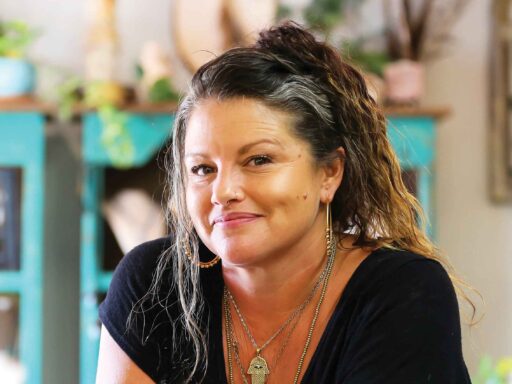



Jen Tobias-Struski
The Emmy-winning host finds her Happy Space in Boerne

Barely a minute after meeting Jen Tobias-Struski in person, it’s clear she is a walking rebuttal to every stereotype of the TV personality skating by on a gift of gab, good looks and a telegenic smile. She certainly has those in abundance, but she reveals much more — quickly and effortlessly.
As we learned in our conversation with the Emmy-winning co-host of “SA Live” and widely acknowledged Renaissance woman of the San Antonio airwaves, Tobias-Struski is also a proud Boerne resident, a devoted wife and mother and a hardworking veteran of today’s local media landscape.
Beneath the winning smile is a thoughtful, genuine commitment to bringing positivity into the lives of her fellow San Antonians—and a sincere champion of Boerne.
Boernean: How long has your family lived in Boerne?
Tobias-Struski: We moved to our Boerne home in 2014, but I’m from San Antonio’s South Side. We moved to Colorado Springs and lived there for three years after I first left the local station here. I had my daughter there and we came back, looked for a place to live, and Boerne was the place I wanted to be. We found a house, fell in love and have been here over a decade.
I love Boerne. Everybody is so sweet whenever I do stories here. I like the sense of community and the way I feel when I’m here. I still have my roots in the South Side, and still visit family, of course, but I’m happy here in Boerne.
Boernean: How does it work, being here, and yet working in the city?
Tobias-Struski: It’s not too bad. During the pandemic, it worked to my benefit. I would come down and do stories here about the struggle, the pandemic, the businesses — which made me draw closer to the community here. I work with the Hill Country Mile to sometimes front stories for their social media, and I got to meet a lot of people. They joke with me at work: “Is this another Boerne story?” Because I’m always favoring Boerne without realizing it. But there’s so much here: more than people realize. I’ve actually used it to my benefit to gather content.
Boernean: Could you walk us through a day in the life of Jen Tobias-Struski?
Tobias-Struski: I try to keep a good schedule. I wake up around 4 a.m and because we have five dogs, I tend to my animals first while everyone’s asleep. I very quietly try to get ready: let them out, make lunches for the kids and try to get out the door by 6:15-6:30 at the latest. The traffic is not too bad that early, so I get to work and start with a 7 a.m. meeting every day.
Our show starts at 10 a.m., so once I’m in, I’m just going-going-going. I’m getting ready right before the show. We start our rehearsals at 9 a.m., so the hour before is all about getting ready for the live show. After the show I have a lot of shoots, just going into different businesses or I edit, write and respond to emails.
I try to finish my day around 2:30 or 3 p.m., then I can get home and get my son from the bus in time. Sometimes I pick up my daughter on the way home. My husband works from home all but one day a week, so he helps a lot.
Boernean: You edit your own video as well? And is that common in the industry today?
Tobias-Struski: I think it is. I started as a video editor, so it’s just my background. I was an MMJ –– a multimedia journalist. So now that I’m a host, I just happen to know how to do everything. I like editing and I love storytelling, so it’s actually something I enjoy. They try to tell me, “Let the photographers help you.” But we have such a small team, it’s a little challenging at times. That is why I tell people that I meet, younger kids, aspiring journalists, that it’s good to wear many hats. Yesterday, I produced the entire show. I haven’t produced in a long time, but I wanted to do an entire Selena show because we had a whole special last night about her. I asked if I could produce the show so that we could cross-promote the evening special. It reminded me how much work goes into it. It’s helpful to understand their perspective: they work hard. They’re the ones writing everything, building the graphics… it humbles me when I’m able to step into the producers’ shoes again.
Boernean: What about lining up guests and the prep work involved with interviews? Is that on your shoulders as well?
Tobias-Struski: It used to be — when I produced. I used to produce five days a week. Now we have two producers who alternate. For the Selena show, I had a vision, and this is what I love about our show: I asked them if I could do this about a month ago, told them it would still be variety. I didn’t want to step on anyone’s toes, but I wanted to run with it. So I scheduled a live shot for our reporter who had an angle at a dance studio, I booked five bakers to do a competition, put together cakes, arranged a fashion angle with a salon owner who had connections with Selena — it was fun. I was able to help the producers, because at this point, I have a lot of contacts. If someone wants to come on the show on a particular day, I’m still helping but it definitely is not all on my shoulders.


Boernean: But it sounds like you enjoy handling so many things.
Tobias-Struski: I do. That’s the problem. They tell me, “Stop it! You’re making your life more difficult!”
Boernean: It sounds like good job security.
Tobias-Struski: [Laughing] I sure hope so! I like working. I love what I do now. The reason I got into news in Colorado Springs was that I wanted to do stories. If you asked the old me, I’d say I wanted to go into journalism for sports and to help kids who don’t have a voice. I wanted to do deep pieces. There’s a lot of child abuse in San Antonio, and it bothered me to see all the police reports. Now, years later and after having kids, I know they can’t handle reading that. It’s too much. So I want to be light, to be positive, I want to show people who are having a bad day that they can turn on and see something good going on in the city.
Boernean: Do you ever think about your children watching your work in years ahead?
Tobias-Struski: I do. They get the perks. My son loves wrestling, and sometimes wrestlers come on the show. They seem proud and happy, and I want them to know the work ethic more than anything else. People will ask them, “Does it bother you that your Mom’s on TV?” Or “Do people recognize her out in public?” — which I don’t get a lot, by the way. But they don’t seem to be bothered by it. They know all about the four o’clock awakenings.
Boernean: You’ve profiled Happy Spaces for your audience, but what is your Happy Space?
Tobias-Struski: I love being at home. Most of all I like going on long walks –– I know that sounds cheesy, but I love clearing my mind. It also helps me generate a lot of ideas. I sometimes put on a podcast, but once a week I drop all of that and just spend time hearing nature.
Boernean: You’ve interviewed a lot of celebrities. Is there any pinch-me moment that stands out?
Tobias-Struski: Yes: Troy Aikman. Growing up a Cowboys fan, watching them with my Dad, and just looking up at him, I was shaking, and so nervous. At first, he wasn’t the friendliest. And that happens: the tricky thing about celebrities. Sometimes they let you down when you meet them. He was a bit distracted by everything going on around us, but he came around. It started when I had to tell him the impact he’d had on my parents and my family: when we’d all get together and watch the Cowboys in our tiny little house. I asked, are you okay, my telling you all of this? And he brightened up and said, ‘I love hearing this!’ The interview went from there.
I also interviewed Matthew McConnaughey, after a lot of persistent bugging when his book came out. He was great. We talked for twenty minutes, and he was everything I’d expected.
Boernean: Tell me about your thoughts for the future, and the industry’s future. Do you want to continue in what you’re doing? And how?
Tobias-Struski: It’s a scary time in the industry right now, from what I’m hearing. I’m glad to be in Lifestyle, because so much is changing in the newsroom. That’s why I try to stay on top of all the skills I can.
AI (Artificial Intelligence) is now coming on, and they’re encouraging us to use it as a tool. New reporters are using ChatGPT all the time. Work ethic is key, as well. You can have people with all of today’s skills, but you have to show up on time. Treat people with respect. I try to show that, and use it as an example with the younger team and interns who come in.
If someone asked me what I’d like to move towards, I’d love to make documentaries in the future. I have a longtime project about a subject I call “The Lost Language.” A lot of us have grandparents who got in trouble for speaking Spanish, so we don’t know [the language]. They thought they were doing us a favor, but now it’s hurting us. I’d really like to finish that project someday.
Boernean: You profile Real San Antonians, and I’m curious: is there an overall profile, or common traits, that you find define San Antonians?
Tobias-Struski: The main thing for me is what they’re doing in the community: something positive. I met these brothers, for example, who’ve opened a non-alcoholic bar. Their mother died of liver disease, and they’re in the South Side, where it’s rare to find an establishment that doesn’t promote drinking. I like people along those lines — who are giving back to the community and making a difference. These are my favorite profiles, but they’re the hardest kind because they’re the most humble people, and they don’t want the spotlight.
Boernean: Are there any specific examples that have stayed with you and meant to you?
Tobias-Struski: One of my favorite stories I’ve ever done is Tony the Sideline Hero. Tony is from the South Side and is a ball-boy at Harlandale High School. He graduated years ago, but he volunteers to help out the team. We need more Tonys in the world. He’s just always there, despite living with some physical issues, and his humility makes him so sweet. That story meant so much to me: his perseverance, and how much of an impact somebody like that can have––just by showing up. He really hit the heart. Also, I was touched just hearing everyone talk about him, from the players to the whole community. He’s in the Harlandale Hall of Fame.
He works at H-E-B handling the carts, but he came on the show when we ran the story. It was a primetime show, a back-to-school special and I was nervous. He was there, all the cheerleaders came to our set, and I had put in so much time putting it all together, staying at work late, hoping to tell it right for him. He was crying. And of course, I was in a corner watching, crying. I wasn’t even in the show that day, but it meant so much to me. And he was ecstatic. He tells me, “I’m more famous now!”
Boernean: That’s a double impact: you’re profiling people who’ve made an impact, but your profile has impacted their lives as well.
Tobias-Struski: And that’s what keeps me going –– that kind of feedback. It’s so fulfilling!